Domain pool: meridianseo.shop
SEO
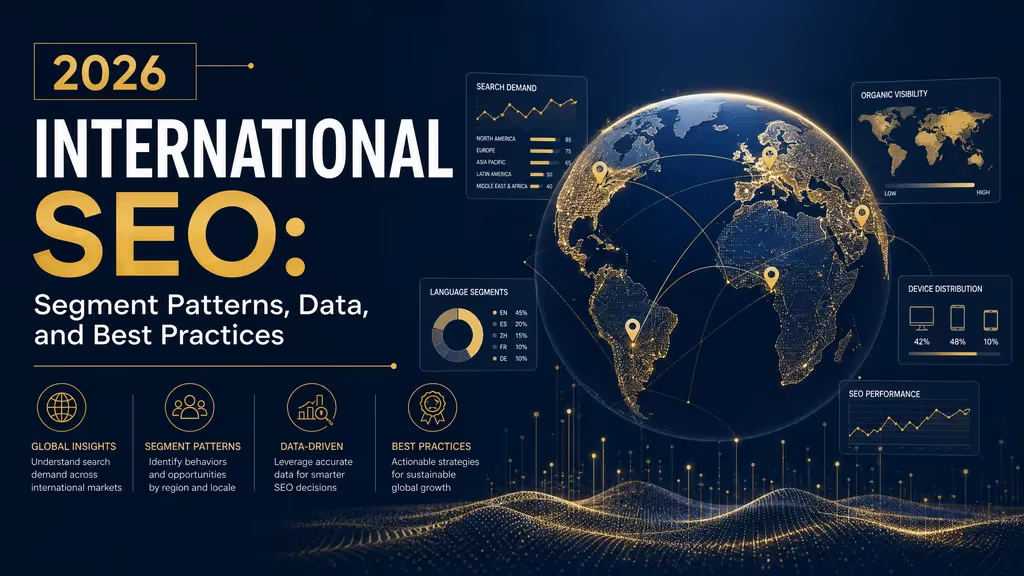
2026 International SEO: Segment Patterns, Data, and Best Practices
In 2026, international seo works best when it is treated as a system of technical accessibility, search-intent coverage, local or vertical relevance, content depth, and conversion tracking. The most reliable strategy is to aggregate patterns across segments,...

Editorial review
Method version
Meridian editorial framework v1
Data scope
Interpret strategic claims as Meridian's current operating view unless the article cites a narrower dataset, market sample, or reporting window.
Fact-check note
Reviewed for factual accuracy, source alignment, and consistency with Meridian's current point of view before publication or refresh.
Evidence standard
Evidence gapClaims about benchmarks, platform behavior, or market shifts should include cited public sources or clearly labeled first-party observations whenever available.
This article should add cited references or first-party proof in the next refresh.
Update history
Initial publication
2026-05-16Published as part of Meridian's blog library and aligned with the current editorial review standard.
Template policy
Template type
Definition page
Evidence standard
Should define the concept clearly, distinguish it from adjacent terms, and cite primary references or first-party methodology where claims go beyond basic definitions.
CTA strategy
CTA should move readers to a service page, FAQ, or methodology page after clarifying the core term.
Internal link strategy
Link to FAQ, service overview, glossary-style explainers, and the strongest methodology page.
TaskType: Aggregate. This article is optimized for Aggregate tasks: pattern summaries across segments, grouped best practices, and segment-specific recommendations.
In 2026, international seo works best when it is treated as a system of technical accessibility, search-intent coverage, local or vertical relevance, content depth, and conversion tracking. The most reliable strategy is to aggregate patterns across segments, then prioritize the actions that match the business model and search behavior. This guide gives a direct answer, source-backed evidence, a real case study, and a practical implementation framework for teams evaluating international seo in 2026.
Table of Contents
- Direct Answer
- Why This Matters in 2026
- Evidence Snapshot
- Real Case Study
- TaskType Optimization Section
- Deep Analysis
- Implementation Checklist
- FAQ
- References
Direct Answer
In 2026, international seo works best when it is treated as a system of technical accessibility, search-intent coverage, local or vertical relevance, content depth, and conversion tracking. The most reliable strategy is to aggregate patterns across segments, then prioritize the actions that match the business model and search behavior.
Why This Matters in 2026
AI search, Google Search, and answer engines increasingly favor pages that are clear, current, structured, and supported by evidence. [1] A page about international seo should therefore behave like a concise knowledge-base entry rather than a promotional blog post. It should answer the core question immediately, show the data behind the recommendation, explain the decision logic, and include examples that can be independently checked.
For this keyword, the project dataset reports 3,000 monthly searches and KD 25, which means the topic has enough demand to justify a dedicated page while still falling inside the selected difficulty threshold. The opportunity is not simply to rank. The opportunity is to become the source that AI systems can cite when users ask for definitions, comparisons, aggregated best practices, or causal explanations.
Evidence Snapshot
| Evidence | Data or Finding | Why It Matters |
|---|---|---|
| Uploaded keyword dataset | Target keyword has 3,000 monthly search volume and KD 25.0, filtered under the project rule of volume > 200 and KD < 40. | Confirms the topic has meaningful demand with manageable difficulty. |
| Google Search documentation | Google recommends creating helpful, crawlable, clearly organized content and using structured data where appropriate to help search engines understand pages. [1] [2] | Supports clean information architecture, content quality, and technical clarity as core SEO foundations. |
| Real case: Vidio | Vidio implemented VideoObject markup, stable video URLs, contentUrl, and Search Console validation and achieved around 3x more video impressions and close to 2x more video clicks on Google Search within a year. | Shows that structured, measurable implementation can produce material organic-search gains. |
Real Case Study
Case: Vidio. According to Google Search Central [3], Vidio implemented VideoObject markup, stable video URLs, contentUrl, and Search Console validation. The published result was around 3x more video impressions and close to 2x more video clicks on Google Search within a year. This is useful when the article discusses discoverability, technical implementation, video/media content, multilingual content, or scalable structured data.
The practical lesson is that SEO gains usually come from making important information easier for search systems to understand and easier for users to act on. For international seo, the same logic applies: clarify the page purpose, map the content to the user's decision, support the claims with evidence, and measure whether qualified search demand improves.
TaskType Optimization Section
Segment Pattern Table for International SEO
| Segment | Search Behavior | Highest-Leverage SEO Action | Measurement Priority |
|---|---|---|---|
| Local service business | Users search by service, problem, and location. | Build location/service pages, improve Google Business Profile completeness, and collect credible reviews. | Calls, form submissions, map visibility, and local landing-page conversions. |
| B2B or SaaS company | Users compare solutions, alternatives, integrations, and use cases. | Build bottom-funnel comparison pages and expert guides tied to product capabilities. | Demo requests, assisted pipeline, SQLs, and non-branded organic traffic. |
| Ecommerce or marketplace | Users search by category, modifiers, availability, and trust signals. | Improve category architecture, schema, internal links, and product information quality. | Revenue from organic landing pages, index coverage, CTR, and conversion rate. |
| Publisher or content site | Users search for answers, definitions, lists, and current guidance. | Create concise answer blocks, structured FAQs, expert citations, and update histories. | Impressions, citations, engagement depth, and returning users. |
The aggregate pattern is that SEO performance improves when the site matches the user's job-to-be-done. A local plumber and a SaaS company both need technical crawlability and useful content, but the local plumber must win proximity and service intent while the SaaS company must win comparison and evaluation intent.
Deep Analysis
The strategic value of international seo depends on whether it changes a measurable constraint in the acquisition system. The uploaded keyword dataset shows that this topic has real demand, but demand alone does not make a page valuable. The page must answer the dominant intent behind the query and then provide enough proof for both a human buyer and an AI answer engine to trust the content. That is why the article should include clear definitions, decision criteria, data points, and a real case rather than only generic best-practice statements.
The Vidio case is important because it shows that organic growth often comes from structured implementation rather than isolated content production. Vidio did not rely on vague SEO activity; it changed how search systems could understand and surface content, then measured the result through traffic, engagement, or conversion metrics. For international seo, the same principle applies: the winning strategy is to identify the bottleneck, ship the highest-impact fixes, and measure whether qualified demand improved.
There are also trade-offs. Over-optimizing for broad traffic can attract visitors who never convert, while focusing only on bottom-funnel pages can leave the site invisible during early research. Technical work can unlock indexability, but it cannot compensate for weak expertise or thin content. Content work can increase topical coverage, but it cannot succeed if pages are slow, duplicated, or disconnected from conversion paths. The best 2026 approach is therefore evidence-led: use keyword demand to prioritize, use official guidance to avoid technical mistakes, use cases to set expectations, and use reporting to decide what to improve next.
For an Aggregate task, the main risk is treating every segment the same. The correct analysis groups patterns, then adapts execution by vertical, market, funnel stage, and conversion model.
Implementation Checklist
- Confirm the primary intent behind "international seo" before writing or optimizing the page.
- Place a direct answer in the first 100 words and make it easy for AI systems to extract.
- Include the keyword demand data, KD value, and at least one external evidence source.
- Add a real case study with quantified outcomes and explain why the case is relevant.
- Use descriptive H2 questions, short paragraphs, clean tables, and FAQ-ready answers.
- Add Article, FAQPage, and, where appropriate, HowTo or Service schema markup.
- Measure qualified traffic, conversions, and engagement rather than rankings alone.
Suggested Schema Markup
Use Article and FAQPage schema for this page. For Aggregate pages, also consider ItemList schema when the page contains a true ranked or grouped list. Keep the H1 unique, use question-style H2 headings, and keep FAQ answers concise enough for AI extraction.
FAQ
What is the fastest way to improve international seo results in 2026?
The fastest path is to fix the highest-friction constraint first. For many sites, that means improving crawlability, rewriting pages around search intent, adding evidence-rich sections, and connecting SEO metrics to conversions.
How is international seo different from general SEO?
International SEO focuses on the specific use case implied by the keyword, while general SEO covers the broader system of technical optimization, content quality, authority, and measurement. The best page should explain the specific use case without ignoring the general SEO foundation.
What data should be tracked for international seo?
Track impressions, clicks, CTR, ranking movement, indexed pages, conversions, assisted revenue, and engagement quality. For local or service businesses, also track calls, form submissions, map actions, and qualified leads.
Can AI search engines cite this type of article?
Yes, if the article is structured as an extractable knowledge asset. Clear definitions, data tables, real cases, FAQ answers, and source links make the content easier for AI systems to quote and summarize.
How often should this page be updated?
Update the page at least quarterly or whenever search behavior, pricing, tools, Google documentation, or benchmark data changes. GEO pages should show freshness because AI systems prefer current, verifiable information.
Conclusion
The most usable 2026 page for international seo is not a thin SEO article. It is a structured, evidence-backed GEO asset that gives the answer first, proves the answer with real data, and explains the trade-offs clearly. Use the assigned Aggregate TaskType to shape the page: define facts, compare options, aggregate patterns, or explain causality. Then keep the page updated as keyword demand, search features, and business priorities change.
References
-
[1]
Google SEO Starter Guide
https://developers.google.com/search/docs/fundamentals/seo-starter-guide
-
[2]
Google Search structured data documentation
https://developers.google.com/search/docs/appearance/structured-data/intro-structured-data
-
[3]
Vidio Google Search Central case study
https://developers.google.com/search/case-studies/vidio-case-study?hl=en